Hero From the Heartland
The Story of Bombardier David W. Fisher Jenny Ashcraft Fold3
How can Fold3® records help tell the story of your military ancestor? We came across an interesting Missing Air Crew Report for a WWII bombardier. That single record led us to additional Fold3® records, Newspapers.com™ clippings, and a Find a Grave™ memorial. Using these combined sources, we’ve pieced together the remarkable service history of David Willard Fisher. This is his story.
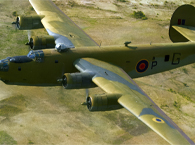
 On May 18, 1944, David W. Fisher and a crew of nine boarded a B-24H for a bombing run over Ploesti, Romania. Their aircraft never landed. After engine trouble, the plane crashed. Two crew members were killed instantly, five were captured and taken POW, and three, including Fisher, made their way to freedom with the help of partisans.
David W. Fisher was born in 1916 in Iowa, the son of James E. and Sophia Raymond Fisher. Raised in Iowa City, Fisher excelled in athletics, lettering in football at Iowa City High School. Following graduation, he married Marguerite Schrader on August 11, 1940. That same year, Congress passed the Selective Training and Service Act of 1940, and by October 1940, all men between the ages of 21 and 35 were required to register with their local draft board. Fisher registered on October 16, 1940.
After Pearl Harbor was bombed on December 7, 1941, the United States entered WWII, and Fisher was called up to serve. He was selected for training as a bombardier in the Army Air Corps and, in December 1943, was commissioned as Second Lieutenant. One day, during a two-mile training run with fellow cadets in Midland, Texas, Fisher impressed fellow airmen with his athletic prowess. A large West Texas jackrabbit lit out in front of the group, and Fisher took off on a sprint in hot pursuit of the rabbit. By the time the other cadets caught up to him, they found he’d outrun the rabbit.
Fisher was assigned to serve in the 459th Bombardment Group, 756th Bomb Squad, and 15th Air Force. He left for Europe on April 17, 1944. His unit participated in a bombing campaign to destroy enemy oil production facilities at Ploesti. Between April and August 1944, the 15th Air Force bombed Ploesti 23 times. More than 200 heavy bombers were downed, and 1,100 bombers became POWs.
On the afternoon of May 18, 1944, Fisher and his crew boarded a B-24 at Giulia Airbase in Italy. Fisher had been in Italy for six months, and this was his fifth mission. After a successful bombing run over Ploesti, the aircraft headed for home but soon developed engine trouble. Pilot Harold W. Helfrich lost sight of his formation and was losing altitude when he sent a distress call. Moments later, the aircraft went into a violent spin.
Crew members struggled to escape, and Fisher was one of the first to jump. He immediately encountered problems when his chute failed to open, and he went into a 5000-foot free fall. In a newspaper interview, Fisher recalled, “I was in a bunched position, my head down, falling headlong wi th my knees drawn up. With a terrible shock, the chute opened. Blood spurted from my mouth and nose, and I felt like a giant hand had torn me in two.”
Fisher and Helfrich landed close together but didn’t know the fate of the other crew members. Fisher was injured, but local partisans arrived on the scene quickly and ushered the two men to safety. Back home, Fisher’s wife received word that he was missing.
For 89 days, Fisher and Helfrich crossed through enemy territory. They received help from a group of partisan fighters led by Josip Broz Tito, a leader of Yugoslav Partisans who would later serve as President of Yugoslavia. The partisans guided them through Yugoslavia and Albania with the enemy in close pursuit – so close that they shot off the heel of Helfrich’s boot. During the three-month ordeal, Fisher developed dysentery and lost almost 50 pounds. In August 1944, Fisher and Helfrich reached Peshkopi, Albania, and were turned over to an English liaison officer. Military officials then evacuated Fisher and Helfrich to a military hospital in Bari, Italy.
After recovering, Fisher returned to the US in October 1944 and was honorably discharged on February 7, 1946. He was awarded the Air Medal with four Oak Leaf Clusters. He lived a long life and passed away in 2010 at age 93.