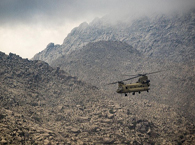
Staff Sgt. Robert J. "Rob" Miller didn't look like the square-jawed "GI Joe" people imagine when they hear "Green Beret." He was a former high-school gymnast, band kid, Boy Scout and part-time surf bum who liked classical music as much as hard rock. He just also happened to be the guy who would one day charge a valley full of enemy fighters so his friends could live.
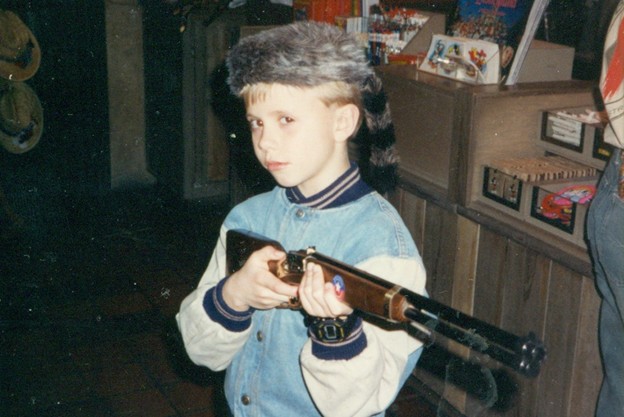 Miller was born in Pennsylvania in 1983, the second of eight kids in a family where military service was basically a family tradition, stretching back to the Revolutionary War. He was named for both grandfathers, World War II veterans, and grew up around stories of war and oppression, including tales from Cambodian refugee friends about surviving the Khmer Rouge. It left him with an early sense that there were, in his words, some truly bad people in the world.
The Millers moved to Wheaton, Illinois, when Rob was five years old. He grew up into the kind of overachiever every coach loves: gymnastics team co-captain, state-level competitor, baseball and basketball, track, Boy Scouts, and school band. If there was a thing to do, he did it, usually at full speed. He was also a history nerd who soaked up his parents' stories about living in the Soviet Union and Berlin during the Cold War, which only sharpened his appreciation for American freedom.
He wanted to take that love of country to the U.S. Naval Academy, but colorblindness killed the plan. He went to the University of Iowa instead, still orbiting the gymnastics world and still thinking about service, especially after 9/11. When he watched classmates casually crumple up an American flag after a meet, he made them fish it out and taught them how to fold it properly.
This was not a guy on the fence about what he believed in.
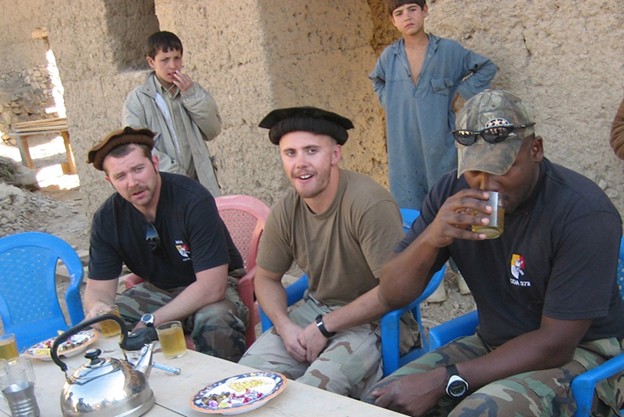 In 2003, after his family moved to Oviedo, Florida, Miller enlisted directly as a Special Forces trainee. He crushed Infantry Basic, Airborne School, the Special Forces Qualification Course, and the Weapons Sergeant Course, earning his SF Tab in 2005 and joining A Company, 3rd Battalion, 3rd Special Forces Group (Airborne) at Fort Bragg. On his first Afghanistan deployment in 2006–2007, he earned two Army Commendation Medals for Valor.
Rob also attacked language like everything else: he picked up French, German, some Russian, and Pashto, which made him the natural point man and talker on patrols. By his second tour in late 2007, the 24-year-old was a seasoned weapons sergeant in Operational Detachment Alpha (ODA) 3312, 3rd Group, rolling into one of the nastiest neighborhoods in Afghanistan: the Gowardesh Valley in Kunar.
Before dawn on January 25, 2008, ODA 3312 and about 15 Afghan National Army soldiers moved into the valley to clear insurgent safe havens and stop attacks on nearby villages. Surveillance showed 15–20 armed men hiding in a compound in the valley. Miller, fluent in Pashto and trusted by the Afghan soldiers, took point for the combined patrol as they crossed into "Ambush Alley," a steep valley with nearly vertical cliffs that looked exactly like the kind of place you'd never want to be ambushed in. Which, of course, is exactly what happened.
Trudging through the snow in the freezing morning, the force encountered two insurgent-placed boulders blocking their path, a sure warning of what was to come. After blowing their way clear, the team headed for the target compound. Upon arrival, they took their positions and used a drone to confirm the insurgents were inside. Miller jumped into his truck's turret, opened up with the Mk-19 grenade launcher, and calmly walked the Air Force onto target over the radio. A-10s and F-15s dropped ordnance on the compound, shredding the first group of fighters.
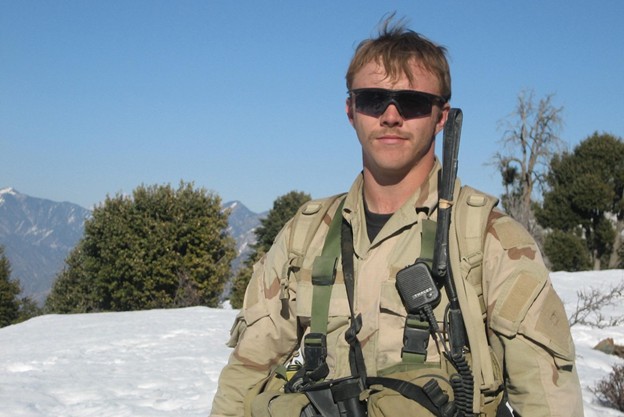 Once the bombs hit, the team pushed forward on foot to see who was left. As they crossed bridge into the steep valley, an insurgent popped up from behind a boulder just a few meters away, shouting and firing. Miller stepped forward and dropped him, but that was the trigger. A company-sized enemy force of roughly 140 fighters erupted from the ridgelines and valley floor with PKM machine guns, RPGs and AKs, hammering the patrol from three sides at ranges under 25 meters.
There was nowhere to hide, but Miller did the opposite anyway. He yelled for his teammates to fall back to cover, then charged straight into the teeth of the ambush with his SAW, engaging multiple positions and wiping out the machine gun and rifle team that had torn into his patrol. Somewhere in that sprint, he was wounded by small arms fire. He kept moving, kept firing, and then pushed farther forward again, deliberately dragging enemy fire onto himself so everyone else could move.
Miller threw grenades into fighting positions, killed or wounded more insurgents, then crawled through the snow, still talking on the radio, still calling out targets even as his detachment commander was hit and ordered the rest of the team to fall back. Only when Rob was sure his teammates were out of immediate danger did he try to find cover himself. A second round, again under the arm and into his upper torso, fatally wounded him. But even then, he kept firing until his SAW ran dry and he'd thrown his last grenade.
 The firefight raged for nearly seven hours. Post-battle reports credited Miller with killing at least 16 insurgents and wounding more than 30, out of a force that suffered over 40 killed and 60 wounded. His actions let seven Green Berets and 15 Afghan soldiers survive an ambush that should have wiped them out.
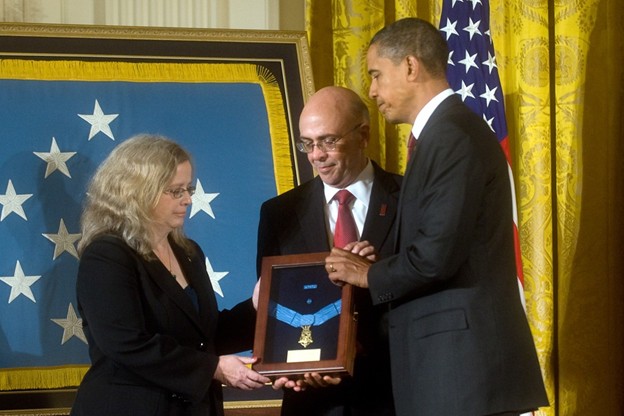
For his bravery and dedication to duty and to his fellow soldiers, Miller received a posthumous Medal of Honor. President Barack Obama presented the medal to Miller's parents, Phil and Maureen Miller, in a White House ceremony on Oct. 6, 2010.
Rob Miller didn't live a long life, but he did live exactly the kind of purposeful life he'd been aiming at since he was that kid in Wheaton correcting flag etiquette. The gymnast, band kid, and linguist grew up to be the Green Beret who chose, in the worst possible moment, to be the one standing between his friends and an entire valley of guns and never step back.
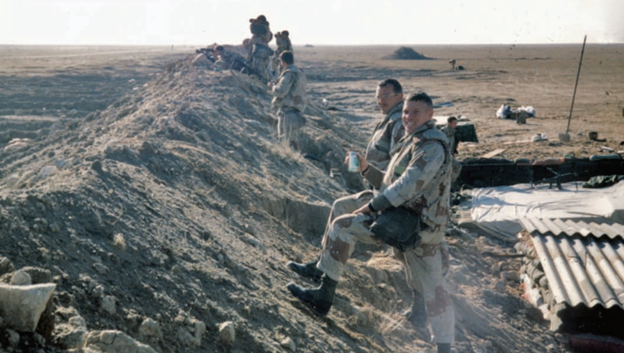
By late January 1991, the "war" part of the Gulf War still looked strangely distant. Since Operation Desert Shield transitioned to Operation Desert Storm, the war appeared very one-sided. Coalition jets had been pounding Iraqi command posts, radars, and armored columns in Kuwait and southern Iraq.
 That was all about to change.
On the ground, Saddam Hussein still had large forces dug in, and he wanted to prove they could strike back against the American-led Coalition defending Saudi Arabia. His chosen target was the quiet Saudi border town of Khafji, just south of Kuwait on the Persian Gulf. It was a tempting target; the Iraqis not only needed a propaganda victory, but it's likely Hussein also wanted a reconnaissance-in-force to probe Coalition defenses and disrupt plans for a ground offensive he knew would be coming.
Khafji had been evacuated of civilians months earlier, but on Iraqi maps it looked ideal: close, symbolic, and apparently lightly defended. Saddam and his generals ordered elements of three divisions—the 3rd Armored, 5th Mechanized, and 1st Mechanized—to push south. One column would drive straight down the coastal highway into Khafji, another would swing through the desert to cut the town off, and a third would shield the western flank while Iraqi artillery and rockets raked the border.
Waiting along the low sand berm that marked the frontier were U.S. Marines and Saudi forces. Light armored infantry from Task Force Shepherd and the 2nd Light Armored Infantry Battalion manned exposed observation posts, backed by Saudi brigades in depth. After dark on January 29, Iraqi armor finally moved. At Observation Post 4, Marine recon troops and light armored vehicles suddenly faced tanks of the Iraqi 3rd Armored Division, and a brutal firefight erupted in the open desert, as missile backblast and tracer fire cut through the night.
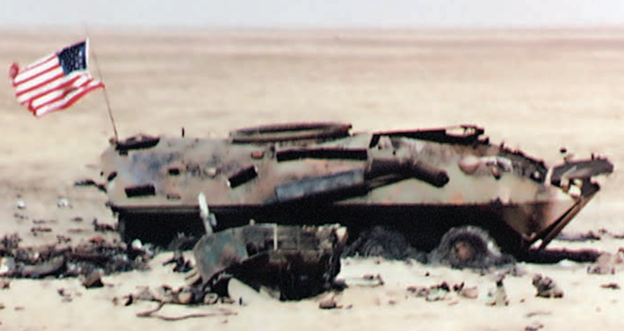 Coalition air and anti-armor fire tore into the Iraqi column, but at a terrible cost. A malfunctioning missile from a U.S. Air Force A-10 Thunderbolt II slammed into a Marine vehicle, and in the confusion, friendly fire helped turn OP-4 into a smoking wreck of shattered LAVs. Eleven Marines were killed, but Iraq's western thrust was badly mauled and stalled north of the berm.
Farther east, the 5th Mechanized Division slipped around the flank. Around 2200 local time, Iraqi troops overran Saudi positions at Observation Posts 7 and 8 and rolled almost unopposed down the highway toward the coast.
In the early hours of the next day, Iraqi tanks and infantry passed under Khafji's concrete entry arches, firing into empty storefronts and apartments as they went. They believed they had stormed a major Coalition base on Saudi soil. In reality, the town had been empty since August, except for two small Marine reconnaissance teams now hiding in buildings, quietly reporting Iraqi movements over the radio and calling in air and artillery strikes on targets in and around the city.
Before dawn, Saudi commander General Khalid bin Sultan and American Gen. Norman Schwarzkopf agreed that Khafji would be retaken primarily by Arab ground forces, backed by overwhelming American air power and artillery. The mission went to the 2nd Saudi Arabian National G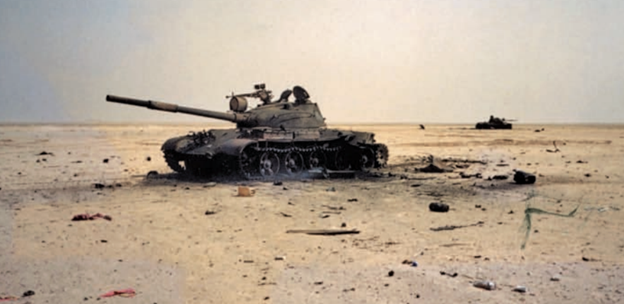 uard Brigade. Its 7th Battalion, mounted in V-150 armored cars and reinforced by a Qatari tank company with AMX-30s, formed the spearhead, guided by U.S. Special Forces and Marine forward air controllers. Late that night, the Saudis and Qataris launched their first counterattack up the coastal highway and into the southern edge of the city.
Outside Khafji, Qatari tanks ambushed Iraqi armor and knocked out several T-55s. Inside the tight streets, however, Iraqi infantry and tanks, dug into firing positions among the buildings, hit the advancing V-150s with rocket-propelled grenades and main-gun rounds. As one Saudi armored car burned beneath the arches, and the 7th Battalion was forced to pull back and regroup. For Iraqi troops in and around the city, the night of 30–31 January was far worse: Coalition aircraft flew hundreds of sorties against armored formations massing north of Khafji, shredding columns still trying to reach the town or escape back toward Kuwait.
That night, Coalition aircraft also smashed an Iraqi amphibious force trying to reinforce Khafji by sea, sinking most of the small craft in the Gulf. Over the border, an AC-130 gunship that stayed on station past sunrise to cover Marines and Saudi troops was shot down by an Iraqi surface-to-air missile, killing all fourteen airmen. At first light on January 31, the Saudi 7th Battalion drove into Khafji from the south, the 8th from the northeast, while the brigade's 5th Battalion blocked the coastal road and ambushed Iraqi reinforcements.
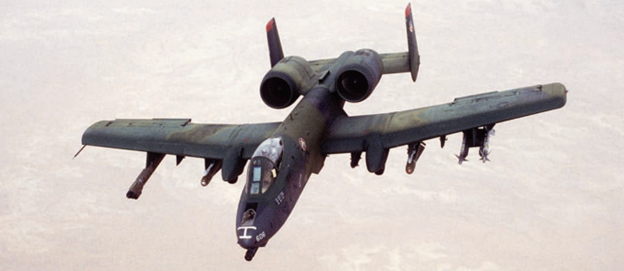 By nightfall, the Iraqi garrison had been carved into pockets, and any vehicle that tried to move in the open was hit from the air. The end came on February 1, when Saudi and Qatari units launched a final push into Khafji as the Marine recon teams slipped out of hiding. Iraqi resistance collapsed; the last companies either surrendered or were destroyed.
In four days of fighting, the Coalition lost 43 dead, 25 Americans and 18 Saudis, while Iraqi divisions left hundreds of men and scores of armored vehicles wrecked, a clear sign they could not withstand the ground offensive that would follow later that month. Khafji was the first major ground engagement of the war and the only time Iraqi forces occupied Saudi territory. It also provided a real-world test of Iraqi tactics and Coalition joint operations for the coming ground offensive.
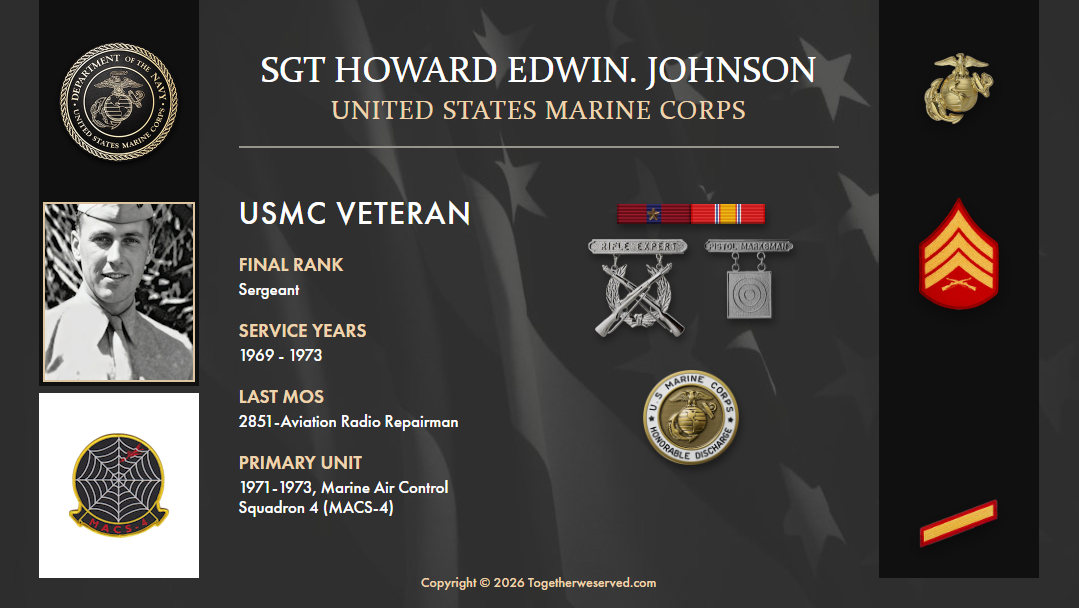
TWS put my name out there so other Marines can reach me. TWS has made me take the time to think about the questions in Service Reflections, bringing back many memories as they were meant to. It is hard to put some of this down in words. I never felt like a True Marine because I had never been in combat. Some of the forums have helped me deal with that doubt. I have enjoyed the forums, and I try to honor those who have passed by reading their obits.
There is nothing else like TWS, and TWS provides a unique connection to the past.
Thank You..
Sgt Howard Johnson, US Marine Veteran
Served 1969-1973
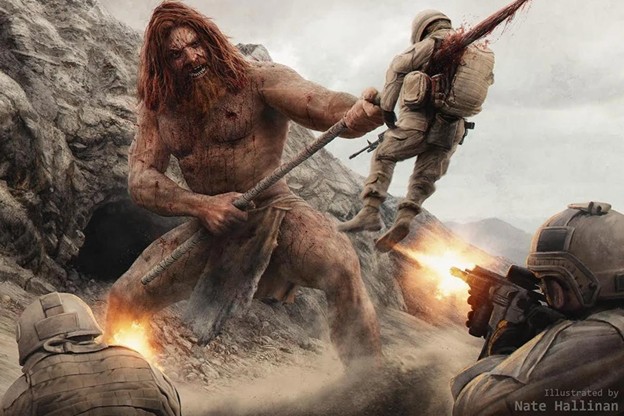 The story of the Kandahar Giant sounds like something from a pulp adventure novel. According to this modern military legend, a unit of U.S. Army Special Forces encountered an enormous, red-haired humanoid in the remote mountains of Kandahar Province, Afghanistan, in 2002. Over the years, the tale has spread far beyond military circles, capturing imaginations but lacking any hard evidence.
As the legend goes, an American patrol had gone missing in the mountains, prompting a Special Forces team to investigate. At a cave entrance high in the hills, the soldiers reportedly found signs of the missing troops, including scattered military equipment and even human remains on the ground.
Before they could search further, a gigantic figure lunged out of the cave and attacked. The creature was described as 12 to 15 feet tall, with a shock of flaming red hair, six fingers on each hand, and two rows of teeth in its snarling mouth. Armed with a massive spear, the giant impaled one soldier (often identified simply as "Dan") with a single blow, fatally wounding him.
The rest of the unit opened fire, unleashing their arsenal to bring the giant down. It allegedly took 30 seconds of sustained fire, rounds from rifles and a .50-caliber sniper rifle, to finally slay the towering foe. Once the dust settled, the soldiers were left staring at the massive corpse of the mysterious attacker.
In the aftermath, the team radioed for a helicopter and loaded the giant's body into a cargo net to be airlifted away. According to the story, the corpse was flown to a U.S. base and never seen again. Some versions of the tale claim the squad was forced to sign non-disclosure agreements to keep the incident secret, which supposedly is why no official report exists.
Unlike most military after-action reports, the Kandahar Giant's story did not emerge from any official channels. It surfaced later via anecdotal retellings. The earliest public mention traces back to the mid-2000s, when author and radio host Steve Quayle recounted the giant encounter on the late-night program "Coast to Coast AM." Quayle's sensational account (involving a lost patrol, a Biblical-sized giant, and a government cover-up) caught the attention of paranormal enthusiasts.
 In 2016, L.A. Marzulli, a filmmaker known for exploring biblical mysteries, featured a dramatized version of the Kandahar Giant clash in his documentary series "Watchers," bringing the tale to a wider audience.
From there, the legend took on a life of its own across the internet. Variations of the story have circulated on message boards, YouTube videos, and cryptid blogs, often embellished with purported "photos" of giants or artistic renderings of the battle. By 2016, the chatter grew loud enough that the fact-checking site Snopes investigated the claims. Not surprisingly, Snopes found no evidence to support the existence of a Kandahar Giant.
Bewildered Pentagon officials responded that they had no record of any such incident. Nonetheless, the lack of official confirmation did little to stop the legend's spread in fringe communities, where some argued that of course the government would deny it.
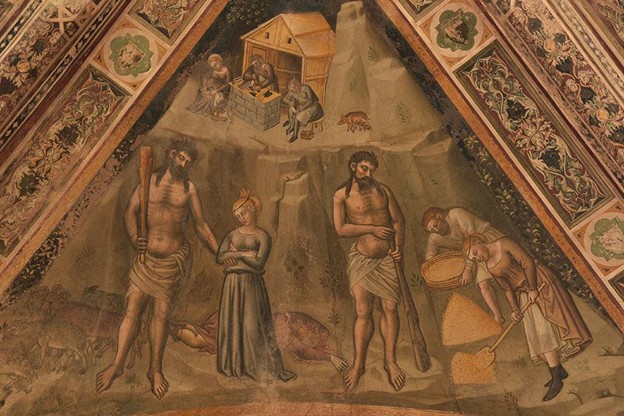
Part of the Kandahar Giant's allure is how it echoes ancient tales of giants in myth and scripture. The creature's described traits, flaming red hair, extra digits, and a taste for human flesh, closely resemble the Nephilim, the race of giant beings mentioned in the Bible. In biblical lore, the Nephilim were offspring of fallen angels and human women, said to roam the earth in antiquity.
It's no coincidence that some proponents of the Kandahar Giant story believe the creature was a literal Nephilim surviving into modern times. In Afghanistan and surrounding regions, folklore is rich with supernatural beings (such as djinn or divs), so a tale of a ferocious giant lurking in a cave can easily feel at home in the cultural imagination. In essence, the legend repackages an age-old archetype into a contemporary war setting.
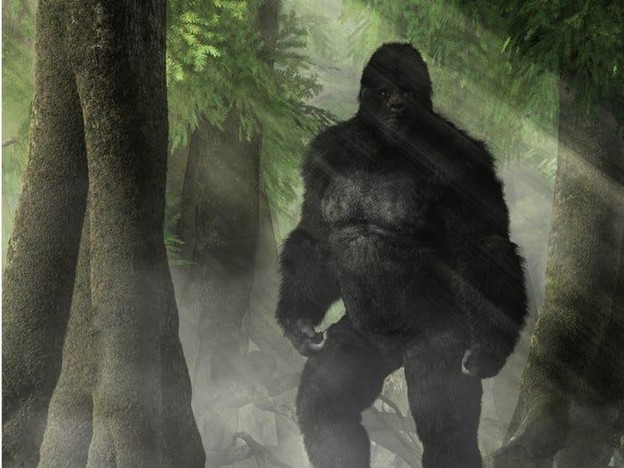 Equally important is the story's place in military folklore. War zones often give rise to their own myths and legends, as soldiers swap eerie stories around base or on patrol. The Kandahar Giant has become a prime example of modern military mythology; a fantastical story born out of the Afghanistan conflict. In much the same way that soldiers in Vietnam spoke of "Rock Apes" or World War II airmen joked about "gremlins," the Giant of Kandahar adds a paranormal twist to the lived experience of war.
Despite the elaborate details and online fervor, the Kandahar Giant legend faces a fundamental problem: no hard evidence whatsoever. There are no official Army reports, no names of verifiable witnesses, no photographs, and no physical remains available for scrutiny. The U.S. Department of Defense flatly states that American forces have never encountered such a creature. Major media outlets have never confirmed the story, and it remains absent from any credible histories of the Afghanistan war. Unsurprisingly, professional fact-checkers and military journalists classify the tale as precisely what it appears to be: a modern myth or hoax.
Believers, however, remain undeterred by the absence of proof. They often claim that evidence was covered up, pointing to the alleged secrecy oaths and the disappearance of the giant's body as reasons why no proof can be found. In their view, the very lack of evidence is itself evidence of a government cover-up. True or not, the tale is a part of our contemporary folklore, reminding us that some legends are just too enticing to fade away.
Although it was absolutely critical to the Union's grand, overarching plan to defeat the Confederate States, we don't hear much about the U.S. Navy during the Civil War, save for a few critical battles. We tend to hear or see even less about the Marine Corps' role in preserving the Union. The simple truth is the Marine Corps was just so small (around 3,000 Marines) compared to the Union Army, and as a result, didn't fight large-formation battles.
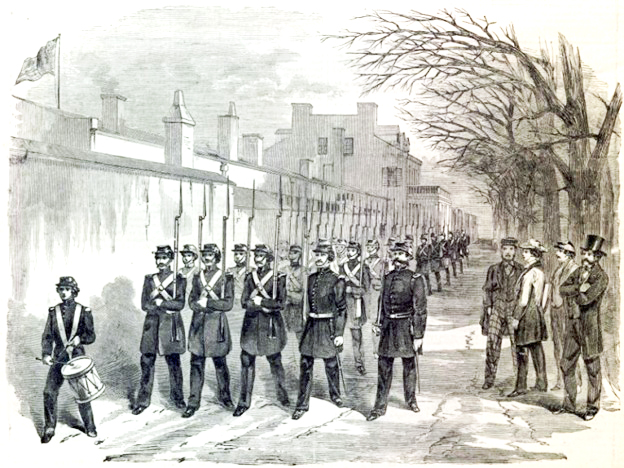 Most importantly, the Corps was struggling to define its role in the U.S. military, but that doesn't mean Marines did nothing of significance during the war. The Anaconda Plan, the Union strategy that would split the Confederacy in two and control the Mississippi River while strangling its ability to trade, get supplies, and sell valuable cotton in foreign markets, required a considerable naval force. It also needed men with the unique skill set of both a land and sea force. That's where the Marine Corps came in.
The Anaconda Plan was Union Gen. Winfield Scott's grand strategy for winning the Civil War by strangling the Confederacy rather than crushing it in one giant battle. The Navy would blockade the entire Southern coastline so the Confederacy couldn't sell cotton or import weapons, while simultaneously seizing control of the Mississippi River to split the South in two and cut off Texas, Arkansas, and Louisiana from the eastern states.
The idea was that, like an anaconda, the North would slowly squeeze the South's economy, logistics, and ability to wage war until it collapsed, ideally minimizing massive, bloody land battles. Critics mocked it as too slow and cautious, but in practice, the Union blockade and the capture of the Mississippi ended up being major pillars of how the North actually won the war.
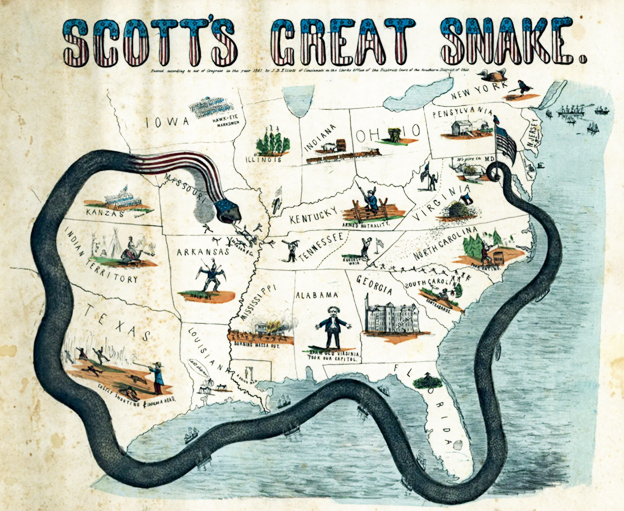 The Civil War is the great age of blue vs. gray armies, not of amphibious expeditionary forces. When the war started, the U.S. Navy was very small, so the Union had to build a large fleet of ships to enforce the blockade, which included river gunboats. It also required cooperation between the Army and Navy to seize and hold the Mississippi River's key ports like New Orleans, Vicksburg, and Memphis. By January 1865, Fort Fisher in North Carolina was the Confederacy's last open gate to the outside world.
Wedged between the Atlantic Ocean and the Cape Fear River, the fort's earthworks and guns guarded the approach to Wilmington, North Carolina, which was the final major port still feeding Robert E. Lee's Army of Northern Virginia. Night after night, sleek blockade runners slipped past Union ships and under the fort's protection, bringing in rifles, boots, blankets, and food that kept the Confederate war effort from collapsing. Union commanders knew that as long as Fort Fisher stood, the Anaconda Plan had a leak. Taking that coastal strongpoint meant cutting the artery that kept Lee's army alive.
A December 1864 attempt to capture the fort had failed, but Union forces were ready again by mid-January of the next year. Scattered across Adm. David Dixon Porter's ships, Marine detachments manned the big naval guns that pounded the fort for days, methodically smashing earthworks, palisades, and artillery. Marines like Orderly Sgt. Isaac Fry and Sgt. Richard Binder on USS Ticonderoga captained guns under brutal conditions, keeping up accurate, sustained fire even when weapons exploded and men were killed around them, work that helped neutralize Confederate batteries and opened the door for a landing. For the final assault on January 15, Porter assembled a "naval brigade" of about 1,600 sailors and 400 Marines to attack the sea face while Maj. Gen. Alfred Terry's Army hit the land side.
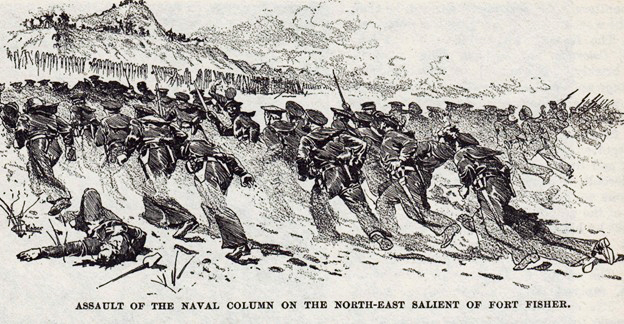 After two days of naval bombardment, the Marines, formed into a battalion under Capt. Lucien Dawson, went in first as skirmishers with rifles and carbines, with columns of cutlass-and-pistol–armed sailors behind them. Crossing open sand toward the Northeast Bastion, they ran into exactly what Confederate Col. William Lamb's gunners and riflemen had prepared: a wall of cannon fire, grape, and musketry. The brigade bunched up at the fort's palisade and was torn apart in minutes.
In that chaos, Marines like Pvt. Henry Thompson pushed as far as the breached palisade under murderous fire, while Cpl. Andrew Tomlin dashed into the open to haul wounded comrades to safety, actions that earned Medals of Honor but couldn't salvage the attack itself.
Tactically, the naval brigade's assault failed, and the Marines paid heavily for it in killed and wounded. But their attack fixed a large part of the rebel garrison's attention and firepower on the sea face, giving Terry's soldiers the distraction they needed to break into the fort along the landward works and fight their way traverse by traverse through the interior.
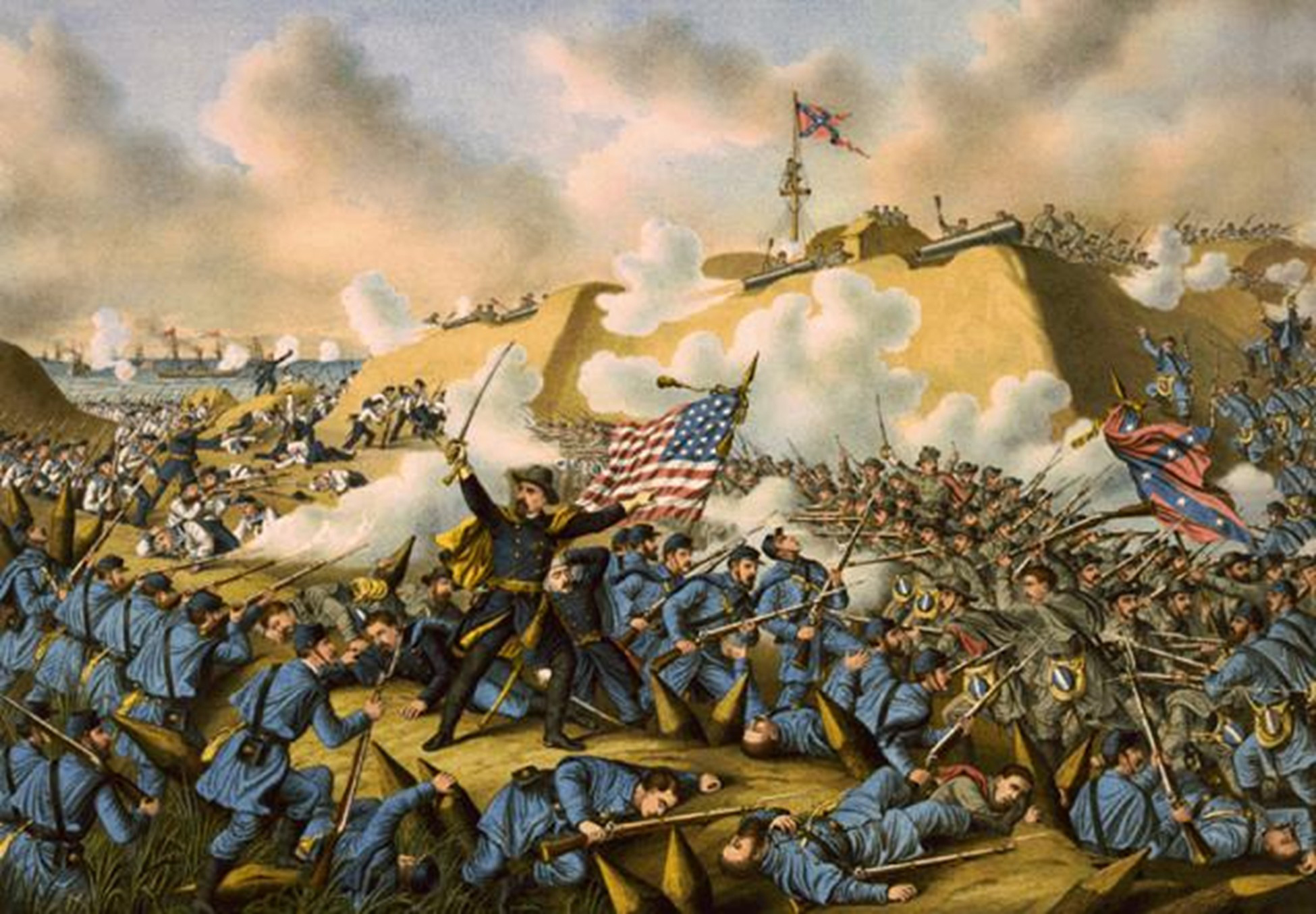 When Fort Fisher finally fell that night, the story of the Marines there was one of disciplined gunnery at sea followed by a brutally costly charge ashore, an operation where their courage and sacrifice under terrible conditions were central to cracking a fortress that had already shrugged off one Union attempt.
Wilmington followed Fort Fisher, and the Confederacy lost its last major seaport and overseas supply line. In the big picture, the Marines at Fort Fisher were doing the same thing they'd done all war: manning the Navy's guns, then stepping into an infantry role when called on, absorbing a disproportionate share of the risk so the larger Union machine could finally finish the job.
The fall of Fort Fisher set off a rapid chain reaction. With the fort silenced, Wilmington fell, and the Confederacy's last real seaport was gone for good. The blockade suddenly became a nearly solid wall, tightening the economic and logistical noose around the South. The assault on Fort Fisher was the Anaconda Plan in its final act: the Union Navy hammering the defenses from offshore, the Army closing in from the beach, Marines and sailors fighting alongside soldiers in a coordinated amphibious attack that would have been unthinkable at the start of the war.
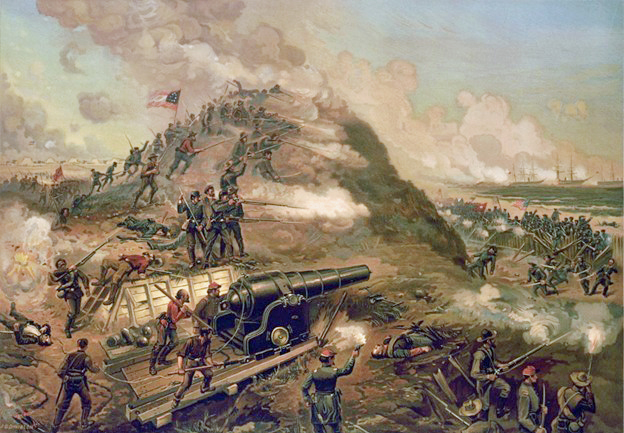 Three months later, Lee surrendered, and the Confederacy was finished. The story of Fort Fisher is the story of how a single fort's fall helped end a rebellion, not by one dramatic clash in an open field, but by shutting the last door through which the South could hope to breathe.
The Corps may have been invisibly tiny compared to the Army; scattered across ships, built for naval security and small landing parties, saddled with bad leadership, and bled of talent when a chunk of its officers went South. But when called on, the Union Marines did their job well. Some 17 Marines would receive the Medal of Honor during the war, a lot compared with the small size of the force. Marines that later earned glory at Belleau Wood and Iwo Jima were shaped by lessons and reforms that came after this war, in part because the Civil War had shown just how marginal the 1860s version of the Corps really was.
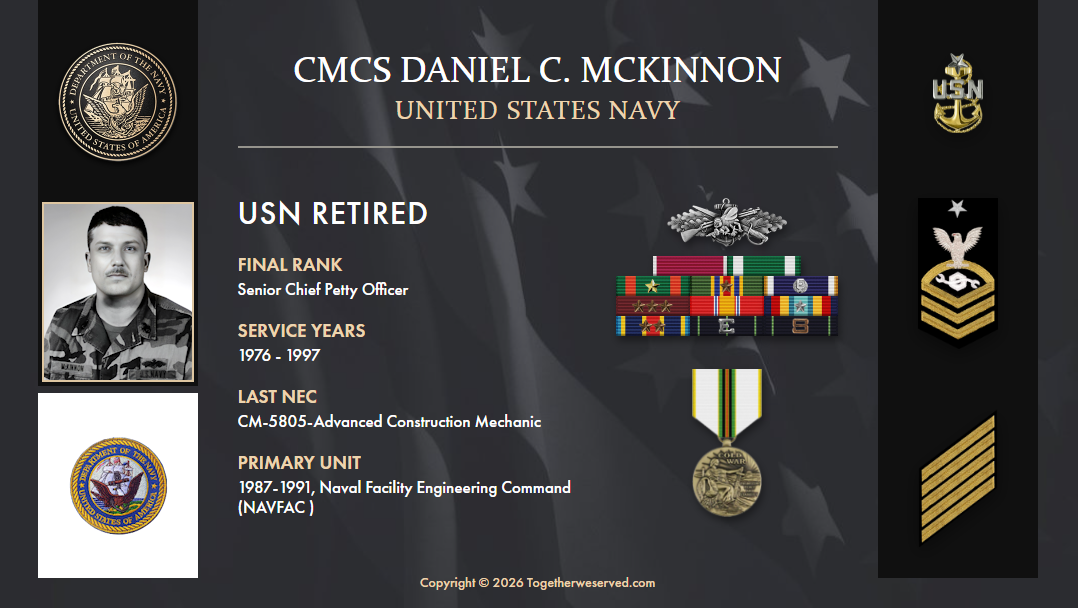
TogetherWeServed.com has been instrumental in helping me reconnect with my military service by prompting me to reflect on my Navy career, spanning from 1976 to 1997, and the many experiences and individuals that shaped it. The platform encouraged me to dig through old photos and memorabilia, sparking memories of my time as a Seabee, though I've realized some details have faded over the years. As I uncover more items or memories resurface, I plan to update my profile to preserve these recollections and honor the connections with friends and shipmates from my service.
CMCS Daniel McKinnon, US Navy (Ret)
Served 1976-1997
By Carmelo J. LoParo
I did what was asked of me and was finally going home.
As the wheels left the ground behind, I felt that I was done.
I didn’t have to pack much and was anxious to leave.
But the memories of war were still with me more than I wanted to believe.
I brought my medals with me and the few things that I shared.
I thought that we were going home to a country that cared.
I thought the plane would be filled with happiness and cheers.
But in fact, there was silence and the sound of several tears.
Most of us were worried that this was all another dream,
One that we experienced almost every night it seemed.
The dream where we were home and lived our lives thereafter.
Only to wake up still in war, surrounded by death and disaster.
When I checked my bags to see if all was there,
I was confident that I brought it all, but still I was scared.
I thought I was leaving behind the memories, deaths and dismay,
But the conflict in my heart and mind just won’t go away.
Between today and when I departed is now more than 50 years.
And the things I brought home that day still cause sleeplessness and tears.
Some of the items I brought with me are my medals and Green Beret.
They now sit on a closet shelf where my Dad’s medals also lay.
My wife was a gift from God, along with our kids and grandkids too.
They are everything one could ask for, a beautiful dream come true.
But when I have another dream that I never really did come home,
The happiness and relief I feel quickly leaves me, as if I were alone.
Has my life been just a dream? Is it now or is it then?
Am I here or am I there? My brain just can’t comprehend.
These dreams are unimaginable unless you have lived them too.
They can affect literally everything you may want to say or do.
My family and friends tell me that I am not alone.
They try to hold and comfort me to assure me that I am home.
I know that they love me as they provide understanding and care.
But the problem is that part of me really is still there.
Captain Carmelo J. LoParo
3/187th Infantry
101st Airborne Division
Vietnam 1971
by Don Mathis
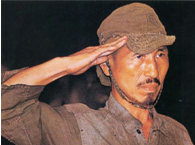
Remembering the End of WWII, the 80th Anniversary
World War II ended 80 years ago with the armistice of 14 August 1945 (Victory Over Japan Day). Two weeks later, the formal surrender was signed on 2 September 1945. But for some holdouts in the Pacific, the struggle continued.
Japanese Lieutenant Hiroo Onoda was the last soldier in the Philippines to lay down his arms. He was finally convinced in 1974 that the war was over, and he began a life worth living. After a period of ranching in Brazil, he established a school in Japan where youth could learn the lessons of nature. Mr. Onoda died in January 2014 at the age of 91. His essence can be summarized in several of his quotations.
Lieutenant Onoda, Sir, reporting for orders.
I will do as you say. I will not complain.
Men should never give up. I never do. I would hate to lose.
One must always be civic-minded.
People cannot live completely by themselves.
Life is not fair and people are not equal.
Some dreams are best not to wake up from.
To remember his service, and that of all soldiers and sailors of WWII, I offer this rensaku, a collection of haiku:
The Ballad of Hiroo Onoda
Hiroo Onoda
Inducted in the army
Under August Moon
Japanese Army
Taught him guerrilla warfare
Spring graduation
1944
Sent to Philippine island
December orders
Never surrender
And never Hari Kari
Live on coconuts
Another August
Another and another
Unit gone, war done
Onoda lived on
He ate bananas when ripe
Killed cow now and then
He never believed
The fight was done, peace declared
Until a spring day
Honorable soldier
Recalled 30 years of war
With a storm of grief
Received a pardon
Hiroo was hailed a hero
Still battled dark thoughts
Japan had transformed
He bought a Brazilian farm
But crops gave no balm
Back to his homeland
A life to help young sprouts grow
Gave him fulfillment
Yet the Philippines
Stayed rooted in memory
He must revisit
So in ‘96
He made a pilgrimage back
Palms swayed, conscience cleared
Now, 2014
The harvest is finally done
The warrior goes home
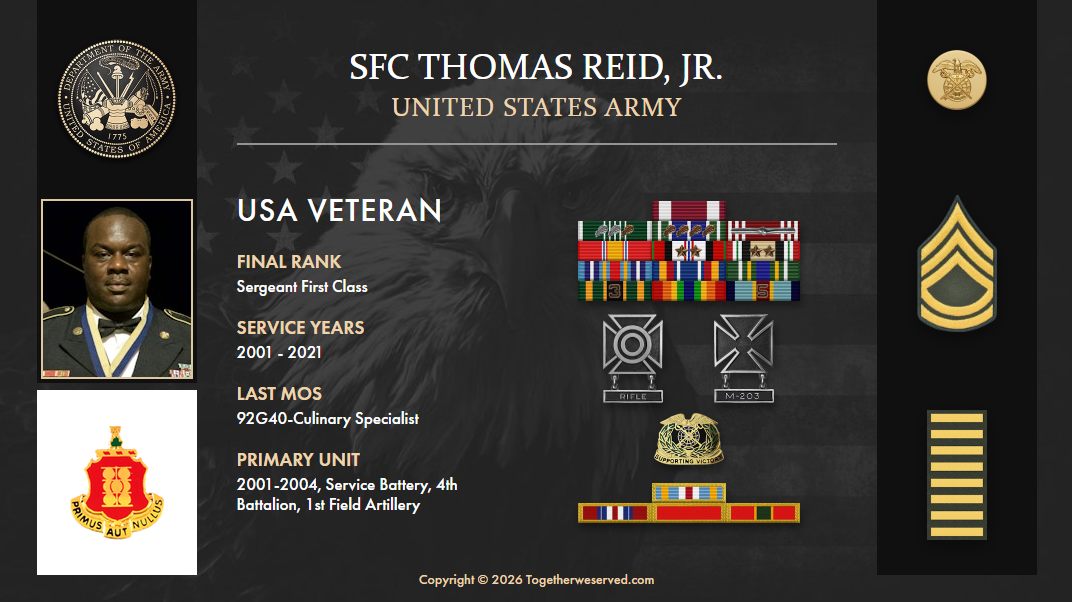
TogetherWeServed.com has been a valuable tool in helping me reconnect with my military past and the friends I served alongside. It allows me to preserve memories, honor our shared experiences, and stay connected with a community that understands the unique bond of military service.
SFC Thomas Reid, Jr., US Army (Ret)
Served 2001-2021
by W.R. Baker

W.R. "Bob" Baker's "Break in the Chain—Intelligence Ignored: Military Intelligence in Vietnam and Why the Easter Offensive Should Have Turned Out Differently" is both a war story and an indictment. It's part memoir from the cramped intel bunkers of I Corps in 1972, and part after-action review of how a major enemy offensive can roar through a command system convinced that it "can't happen here."
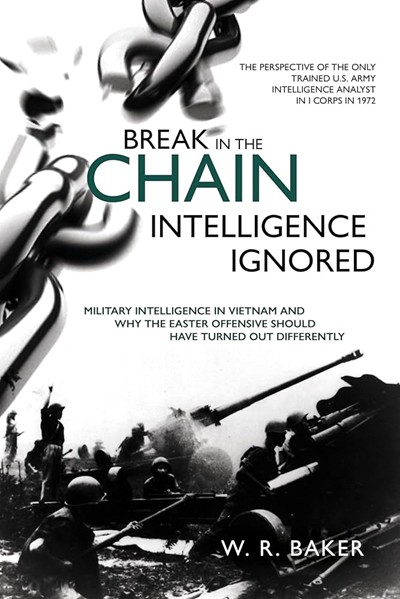 Baker isn't an armchair critic parachuting into history decades later. He graduated first in the Army's inaugural Intelligence (Order of Battle) Analyst course at Fort Huachuca in 1971 and was sent straight to Da Nang, where he became the sole trained intelligence analyst in the 571st Military Intelligence Detachment/525th MI Group, effectively the only U.S. intelligence unit still operating in I Corps at the time of the Easter Offensive.
After Vietnam, he worked as a forward-area watch analyst and electronic order of battle specialist on Syria, Lebanon, Africa's eastern littoral, Iraq during the Iran–Iraq War, and Poland during the crisis years at the European Defense Analysis Center, earning the Bronze Star, Defense Meritorious Service, Joint Service and Army Commendation Medals. That background gives the book real credibility: this is a technician talking about a system he knows from the inside.
The core of "Break in the Chain" is Baker's reconstruction of how the 571st Detachment collected and analyzed human and technical intelligence in the months leading up to the 1972 Easter Offensive and how their warnings were shrugged off. He walks the reader through agent reports, order-of-battle changes, and patterns in North Vietnamese movements that, in his telling, clearly signaled a large, armor-supported offensive through I Corps, not a limited Tet-style flare-up elsewhere.
When the offensive finally crashes across the DMZ, the book shifts from "this is what we saw coming" to "this is what it felt like when no one had prepared:" no on-call units to rescue downed aircrew, reconnaissance platoons disbanded, and a command structure improvising under fire.
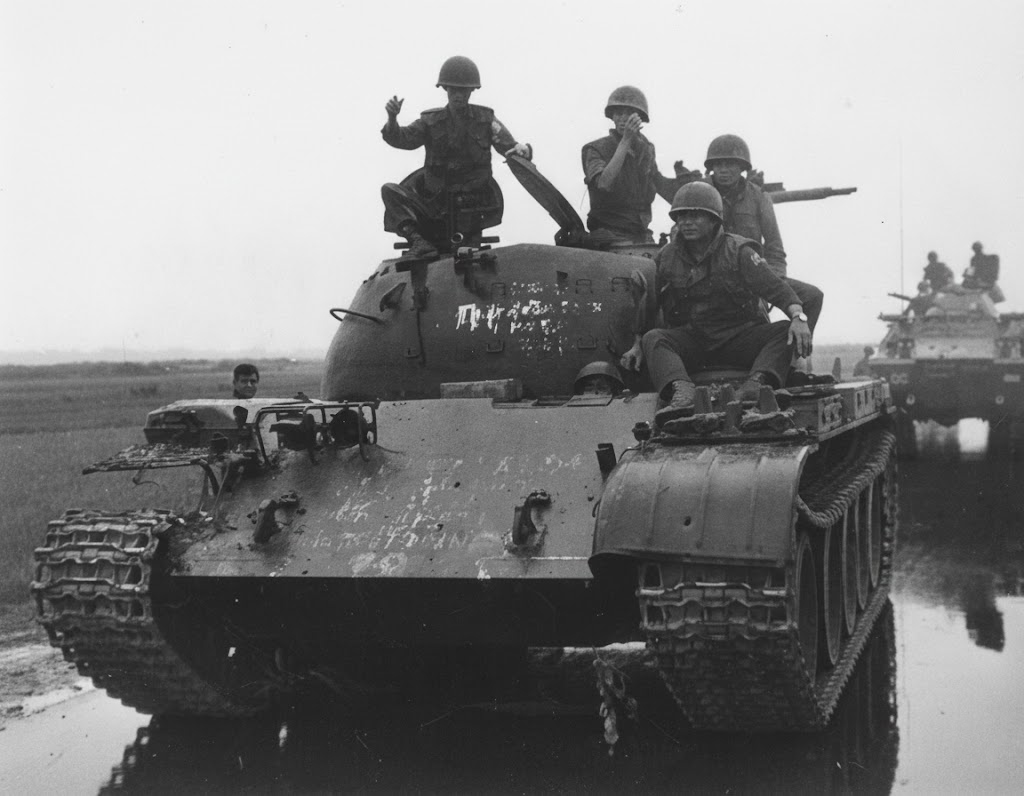 Baker also has an argument, not just a narrative. He explicitly frames Easter '72 as another entry in the long catalog of ignored-intelligence disasters, comparing the failure to heed his detachment's reporting to the lead-up to the Battle of the Bulge, Operation Market Garden, and later U.S. missteps in Iraq and Afghanistan.
The book has been praised by reviewers in publications like Military Review, American Intelligence Journal, and Studies in Intelligence as a compact but deeply sourced case study in how staff officers and commanders should (and too often don't) integrate intelligence into planning.
As a read, it's surprisingly brisk for what could have been a phone book of acronyms. Baker writes plainly, mixing enough personal detail—being an "Army brat," living in-country, dealing with personality clashes in the intel world—to keep you anchored, but the real energy is in the reconstruction of the intel picture and the slow, infuriating sense that no one up the chain wants to hear bad news. If you like operations and staff-process detail, it's catnip.
 The only real limitation is that the book is very much the view from one detachment and one professional tribe (intelligence), so South Vietnamese politics, high-level U.S. strategy, and enemy decision-making appear mostly as they refract through his analytic lens. That's not a flaw so much as a boundary condition: this is a specialist's brief, not a total history of the Easter Offensive.
Overall, "Break in the Chain" is a tight, useful book: essential for intelligence professionals and staff officers, and genuinely illuminating for anyone writing about the late Vietnam War. It's a reminder that wars don't just turn on courage or hardware, they also turn on whether the people in charge are willing to listen to the experts in the back room they hired to make these kinds of assessments.
"Break in the Chain—Intelligence Ignored: Military Intelligence in Vietnam and Why the Easter Offensive Should Have Turned Out Differently" by W.R. Baker is available on Kindle and in Hardcover on Amazon, and in hardcover on Abe Books for around $25.